|
Subscribe to the
IAAS Monthly Astronomy Newsletter
(Email version)
SUBSCRIBE
Subscription notes below.
Donate to the IAAS!
Your contributions are tax deductible.
Thank you for your support!
Web and email hosting by
TotalChoice Hosting
|

Create your own visitor map!
An Open Invitation
For amateur radio operators and scanner enthusiasts around the world, please join the Colorado Astronomy Net on the Rocky Mountain Radio League's K1DUN repeater on 449.450 MHz or other digital and analog repeaters, Allstar nodes, Echolinks, DMR and internet links connected to the SKYHUBLINK system. The net meets on Tuesday nights at 7 P.M. Mountain Time (US) (Wednesday at 0200 GMT). Connecting to the SkyHubLink system has expanded our coverage in the U.S., Canada and internationally. All Amateur radio operators worldwide are welcome. Anyone may listen to the net. The RMRL provides a "Live Audio Feed" using Broadcastify.
The Colorado Astronomy Net is now on YouTube!!
All are welcome to join us Tuesday evenings!
Obtain your Amateur Radio (Ham) License or your General Radio Operator's License (GROL)! Visit the South Metro VE Team website for more information. The South Metro VE Team provides test sessions by appointment only. Check the website for current information. All others interested in Amateur Radio, check out the Amateur Radio Relay League website to find out more information about becoming an Amateur Radio operator.
The Colorado Astronomy Net and the IAAS are on Facebook.
Please be sure to "Like" us!
Donate to the IAAS!
Your contributions are tax deductible.
Thank you for your support!
 |
Excerpts from JPL mission updates are provided as a public service as part
of the JPL Solar System Ambassador/NASA Outreach program.
For special JPL programs and presentations in your area visit the JPL Solar System Ambassador website.
(Click on the logo to link to the JPL SSA homepage.)
|
In this Newsletter...
Background screen credits: NGC5775
Imaged March 21/22, 2001
using the 16" Kitt Peak Visitors Center telescope
as part of the
Kitt Peak Advanced Observing Program.
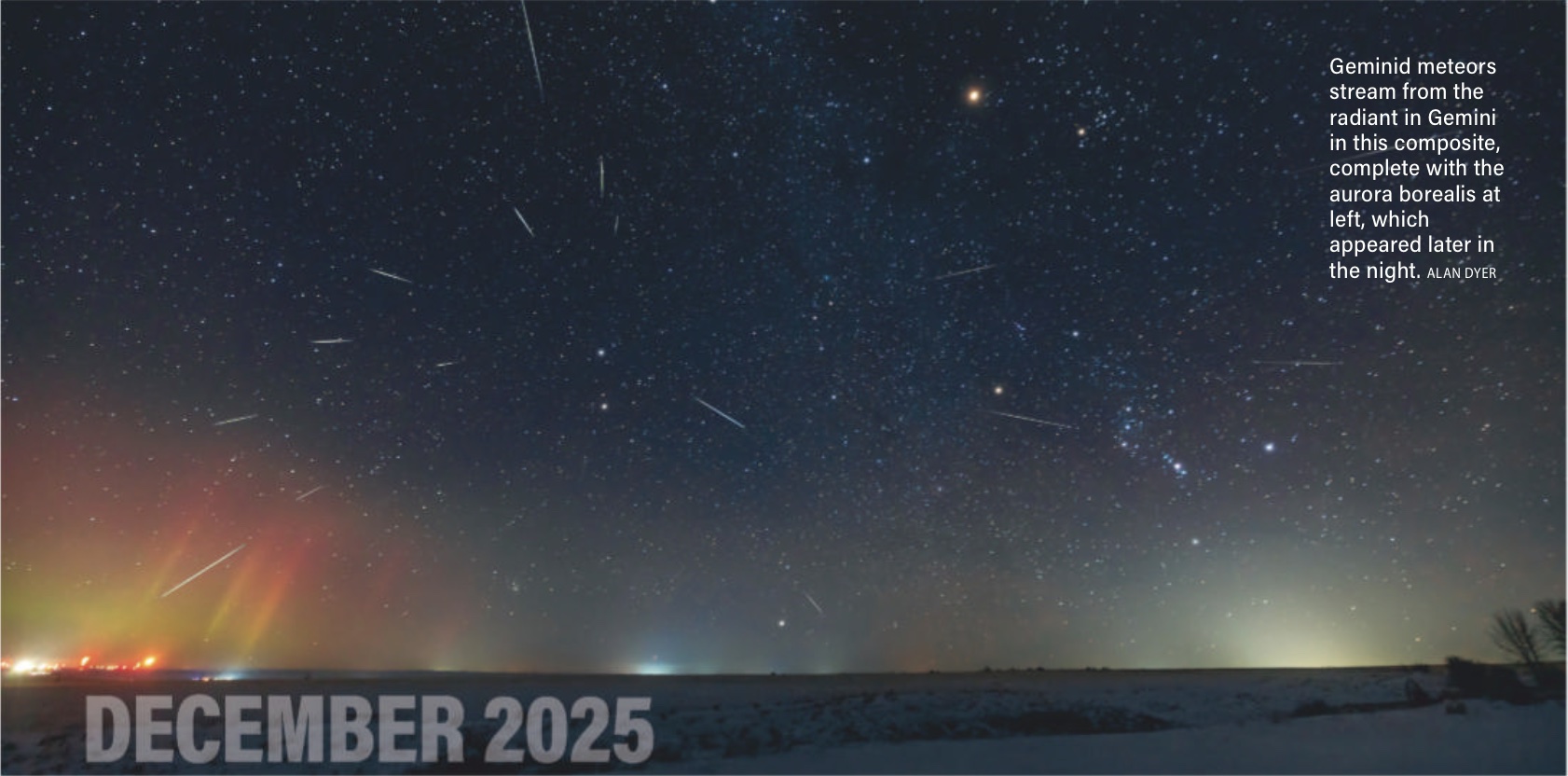
"Geminid meteors stream from the radiant in Gemini in this composite, complete with the aurora borealis at left, which appeared later in the night."
Alan Dyer, Astronomy Magazine, December 2025, p.28.
The Month At-A-Glance
A calendar displaying the daily astronomical events.
Phases
- Full Moon occurs on the 4th. Super Moon
- Last Quarter Moon occurs on the 11th.
- New Moon occurs on the 19th.
- First Quarter Moon occurs on the 27th.
Apogee/Perigee
- The Moon is at perigee (221,806 miles from Earth) on the 4th.
- The Moon is at apogee (252,477 miles from Earth) on the 17th.
Moon/Planet Pairs
- The Moon passes 5° north of Uranus on the 3rd.
- The Moon passes 4° north of Jupiter on the 7th.
- The Moon passes 0.7° north of Regulus on the 10th.
- The Moon passes 6° south of Mercury on the 18th.
- The Moon passes 0.4° south of Antares on the 18th.
- Mercury passes 6° north of Antares on the 18th.
- The Moon passes 0.6° north of Pluto on the 22nd.
- The Moon passes 4° north of Saturn on the 26th.
- The Moon passes 3° north of Neptune on the 27th.
- The Moon passes 5° north of Uranus on the 31st.
For reference: The Full Moon subtends an angle of ~0.5°.
Return to Top
Calendar of All Astronomical Events 2025
Planetary Reports generated by "TheSkyX" software. These reports provide predicted data for the planets for the first of each month for the current year. The rise and set times for the Sun and the Moon for each day of the month as well as meteor shower radiants are also included in the reports. These reports have been optimized for the Denver, Colorado location, however, the times will be approximate for other locations on Earth.
(Times are Mountain Time (MST/MDT) unless otherwise noted. Times will vary slightly depending on your location.)
|
Planetary Highlights for December
"The long nights of December are an astronomical delight. The early evening sky hosts Saturn as the main feature, along with Uranus and Neptune. Jupiter rises later and is visible all night, its four main satellites undergoing many notable events. The morning sky shows the best Northern Hemisphere appearance of Mercury for the year." Astronomy Magazine, December 2025, p.28.
|
 |
Mercury
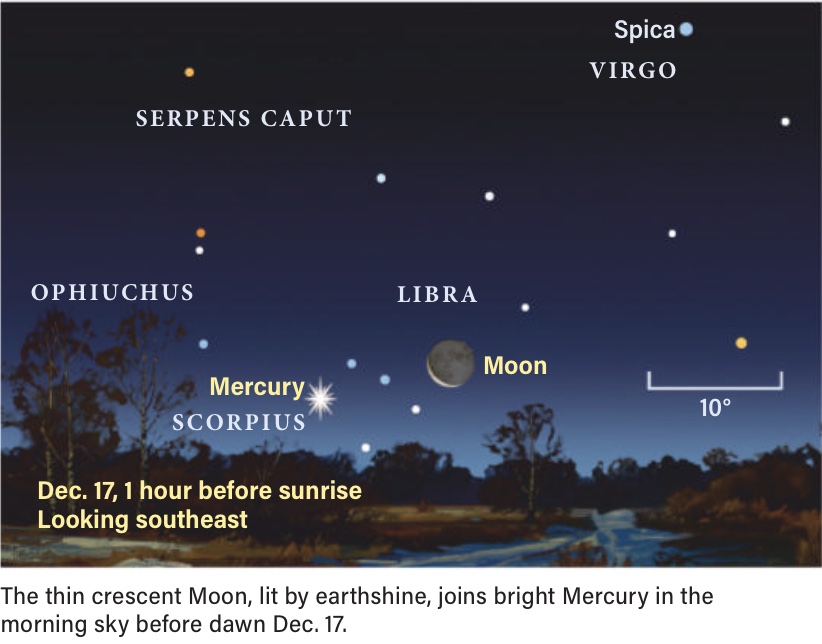 Is at greatest western elongation (21°) on the 7th. Mercury rises at 5:24 a.m. on the 1st and about 6:36 a.m. by month's end. Mercury is visible about 30 minutes before sunrise, low to the east. Mercury moves from the constellation of Libra into Sagittarius shining at magnitude 0.1 on the 1st.
|
 |
Venus
Rises about 6:18 a.m. on the 1st and about 7:20 a.m. by month's end. Look for Venus to the east about an 30 minutes before sunrise during the first two weeks of the month. Venus moves from the constellation of Libra into Sagittarius shining at magnitude -3.9 on the 15th.
|
 |
Earth
Winter solstice occurs at 10:03 A.M. EST on the 21st.
|
 |
Mars
Sets at 5:10 p.m. on the 1st and about 4:51 p.m. by month's end. Look for Mars low to the west in the evening about 30 minutes after sunset during the first two weeks of the month. Mars moves from the constellation of Ophiuchus into Sagittarius shining at magnitude 1.2.
|
 |
Jupiter
Rises at 7:42 p.m. on the 1st and about 5:24 p.m. by month's end. Look for Jupiter to the southeast in the evening, then follow it through the night sky as it sets in the early morning hours before dawn. Jupiter is in the constellation of Gemini shining at magnitude -2.6.
|
 |
Saturn
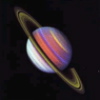
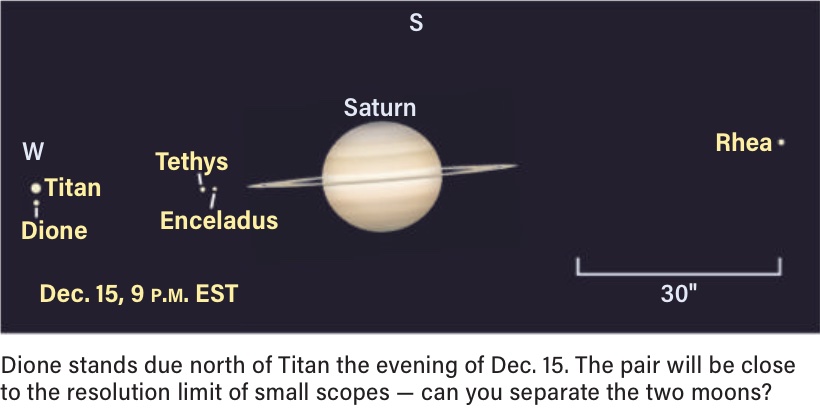 Rises at 1:13 p.m. on the 1st and about 11:13 a.m. by month's end. Look for Saturn to the south in the evening sky, soon after sunset. Saturn is in the constellation of Aquarius shining at magnitude 1.0.
|
 |
Uranus
Rises about 3:51 p.m. on the 1st and about 1:45 p.m. by month's end. Look for Uranus to the south in the evening. Uranus is in the constellation Taurus shining at magnitude 5.6.
|
 |
Neptune
Is stationary on the 10th. Neptune rises at 1:18 p.m. on the 1st and about 11:16 a.m. by the month's end. Look for Neptune to the south in the evening just east following Saturn by a few minutes all month. Neptune is in the constellation of Pisces shining at magnitude 7.7.
|
|
|
Dwarf Planets |
 |
Ceres
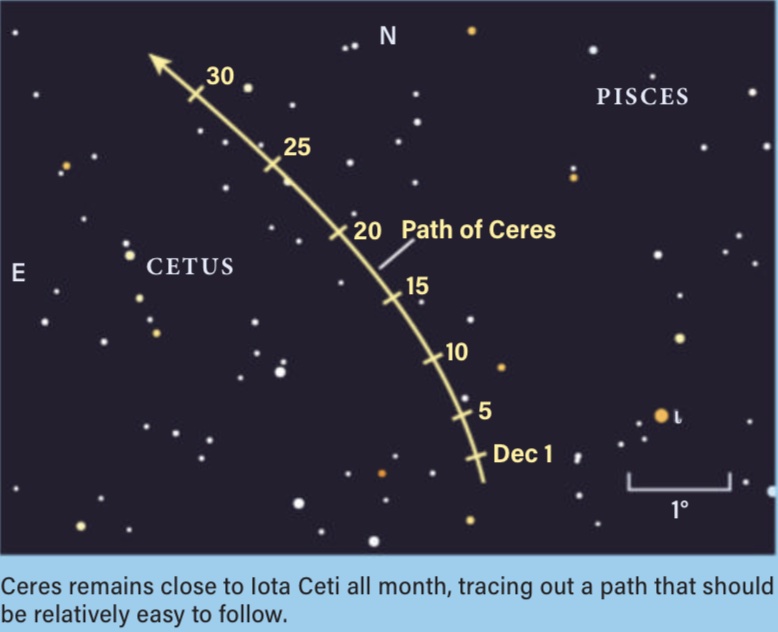 Rises at 2:12 p.m. on the 1st and about 12:09 p.m. by month's end. Ceres can be spotted low to the south just below and east of Saturn and Neptune. Ceres is in the constellation of Cetus shining at magnitude 8.7.
|
 |
Pluto
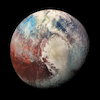
Sets at 8:13 p.m. on the 1st and about 6:16 p.m. by month's end. The best time to spot Pluto will be about an hour after sunset to the southwest. Pluto is in the constellation of Capricornus shining at magnitude 15.3.
As always, good luck at spotting Neptune, Ceres and Pluto, a large telescope and dark skies will be needed.
Constellation information provided by Go Astronomy.
|
Return to Top
 |
Meteor Showers
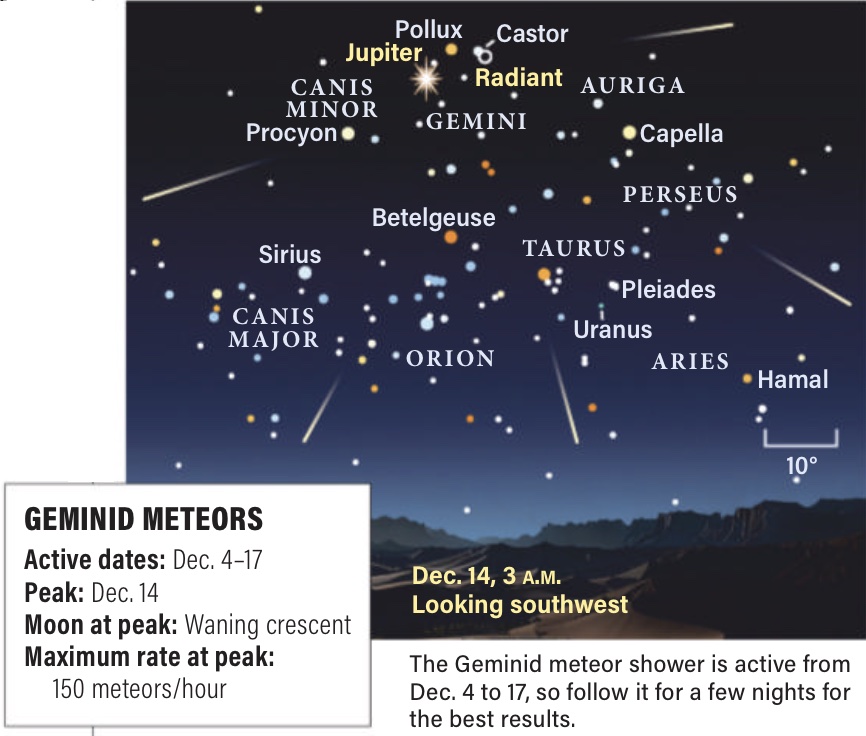
The Geminids - This shower is active during the period December 6 to December 19. Upon reaching maximum activity during December 13 to 14, hourly rates are typically near 80. The meteors are described as rapid and yellowish, with about 4% displaying persistent trains. They possess an average magnitude of 2.4.
The Geminids on FM: A Celestial Symphony You Can Hear - Radio World
The Ursids - Occurring primarily between December 17 and 24, this meteor shower reaches maximum on December 22... The maximum hourly rate is usually between 10 and 15... Meteors belonging to this stream are typically faint.
For more information about Meteor Showers, visit Gary Kronk's
Meteor Showers Online web page.
Meteor Shower Radiant Report
Meteor Scatter (or Meteor burst communications) - "is a radio propagation mode that exploits the ionized trails of meteors during atmospheric entry to establish brief communications paths between radio stations up to 2,250 kilometres (1,400 mi) apart." Tune your shortwave or your HF amateur radio to 54.310 MHz SSB and see if you can hear any pings. Try other frequencies as well... 6m FT8 digital - 50.313 Mhz & 50.276 Mhz, JP-65 digital mode and the carrier frequencies of the lower VHF bands for TV channels 2, 3 & 4.
Meteor Rx How-To by Terry Bullett (WØASP)
|
 |
Comets
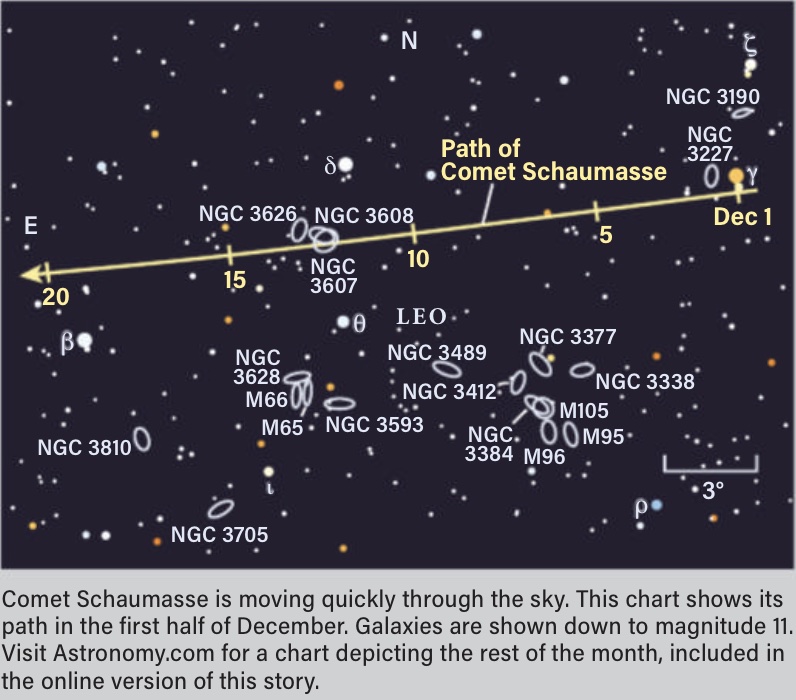
"Comet 24P/s rises around midnight, making it worthwhile to stay up late, especially on the weekend of the Geminids. On Friday the 12th, it shares a low-power field with NGC 3607 and 3608 (10th and 11th magnitude, respectively). With Schaumasse forecast at 9th to 12th magnitude, you can estimate its brightness easily. Use detailed charts to make sure you're not misidentifying a background galaxy!" Astronomy Magazine, December 2025, p.34.
For information, orbital elements and ephemerides on observable comets, visit
Observable Comets.
For more information about Comets, visit Gary Kronk's
Cometography.com webpage. |
|
Eclipses
Solar Eclipses
No solar eclipse activity this month.
Lunar Eclipses
No lunar eclipse activity this month.
|
 |
Observational Opportunities
Look for Mars and Pluto in the early evening to the southwest.
Look for Saturn, Neptune, Ceres, Jupiter and Uranus in the evening and early morning to the south.
Look for Venus and Mercury in the morning to the east.
 |
Asteroids
(From west to east)
- Hebe is in the constellation of Aquarius.
- Papagena is in the constellation of Cetus.
- Psyche is at opposition on the 7th in the constellation of Taurus.
- Harmonia is in the constellation of Gemini.
- Nysa is in the constellation of Cancer.
- Iris is in the constellation of Sextans.
- Information about the Minor Planets can be found at
the Minor Planet Observer website.
|
 |
Ocultations
Information on various
occultations can be found by clicking the IOTA logo.
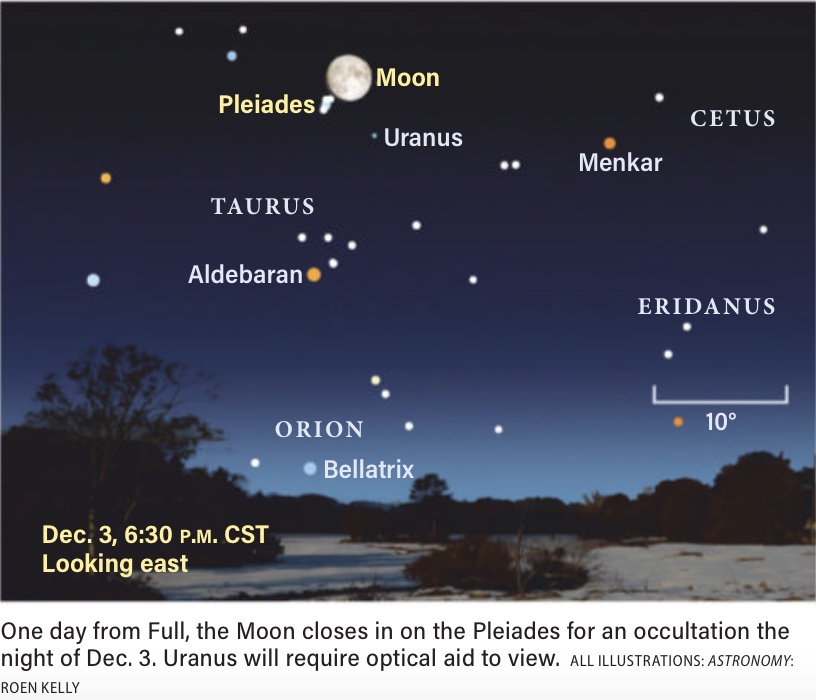
The Moon occults the Pleiades on the 3rd.
|
|
Return to Top
In this section I will post meteor, fireball, etc sightings that have been published on the American Meteor Society's web site. I want to make this an active section of the web pages and newsletter and would like to publish the links to member sightings. If you have any published sightings, please provide me with the links and I will post them here for all to enjoy.
| Event ID |
Date/Time |
Location |
Observer |
Link |
| 3871-2015 |
2015-11-13 01:55 MST |
CO |
Charles N |
3871a |
| 3587-2015 |
2015-11-22 17:38 MST |
CO |
Kevin S |
3587aw |
| 3829-2015 |
2015-12-05 18:06 MST |
CO |
Burness A |
3829a |
| 986-2020 |
2020-02-21 22:20 MST |
CO |
Lukas S |
986 |
| 3716-2020 |
2020-07-24 23:22 MDT |
CO |
Lukas S |
3716 |
| 4774-2021 |
2021-08-13 21:57 MDT |
UT |
Lukas S |
4774 |
| 7044-2021 |
2021-10-28 20:37 MDT |
CO |
Burness A |
249058 |
| 6763-2022 |
2022-10-06 05:56 CDT |
OK |
Mike C |
6763 |
| 5300-2023 |
2023-09-11 22:04 MDT |
CO |
Lukas S |
5300 |
| 578-2024 |
2024-01-28 23:05 MST |
CO |
Lukas S |
578 |
Return to Top
I have created a web page containing images taken and submitted by subscribers (or special images) to the email newsletter, check-ins to the Colorado Astronomy Net and readers of the online newsletter. Any one wishing to submit their own images to the gallery, please let me know. The images must be taken by the submitter and be astronomy related. Please include a description and your information so that I can give proper credit to your work.
Featured Images
Auroral Activity - November 11, 2025
Contributors from---
Strasburg, Colorado -- Frederick, Colorado -- Littleton, Colorado
-- Lynchburg, Ohio -- Paris, Texas
Images taken November 11, 2025
 |
The Sun was quite active on the evening of November 11, 2025 (November 12 UTC). Auroral activity was seen as far south as Paris Texas. Many of our Colorado Astronomy Net participants and IAAS members sent in their images of this rare event so far south.
Here is the link from SpaceWeather.com for November 11, Severe Geomagnetic Storm Watch, explaining what was occurring with our dynamic Sun.
(Click on the following link(s) to start the slideshow.)
(Full screen with sound.)
Aurora Activity 11/11/25 - MPEG-4 (.m4v) format
Aurora Activity 11/11/25 - QuickTime (.mov) format
Return to Top
(Excerpts from recent JPL mission updates)
Past, Present, Future and Proposed JPL Missions.
For special JPL programs and presentations in your area visit the JPL Solar System Ambassador web site.
Return to Top

Mars website mobile version is here!
Return to Top
(If you have a link you would like to recommend to our readers, please feel free to submit it.)

- Brighton Astronomy Group - Astronomy in Brighton, Colorado (under construction).
- Cloudbait Observatory, Guffey Colorado - Submit your fireball reports here. Interesting, knowledgeable site.
- Colorado Springs Astronomical Society - The Colorado Springs Astronomical Society (CSAS) is a nonprofit organization dedicated to the enjoyment of the nighttime sky.
- Denver Astronomical Society - The Deep Space Exploration Society is a Colorado based nonprofit organization dedicated to practical astronomy and space science education for students, the general public, and society members.
- Deep Space Exploration Society - Promotes the enjoyment and understanding of astronomical phenomena, history and lore by providing educational and observing opportunities for our members, general public, and outreach activities at the University of Denver's historic Chamberlin Observatory, schools, and nature centers.
- Little Thompson Observatory - Begin or sustain your interest in astronomy at LTO! The night sky is wondrous, filled with countless swirling galaxies, the planets, the moon and so much more. Many of these sights are easily visible from Earth, but few people have witnessed them personally.
The Little Thompson Observatory can change that for you. Our mission is to help people of all ages learn about the universe by offering a first-hand experience with astronomy...
- National Space Science & Technology Institute - NSSTI runs the Star Light—Star Bright Observatory in Colorado Springs, Colorado.
- Northern Colorado Astronomical Society - The Northern Colorado Astronomical Society is a non-profit organization dedicated to promoting the science of astronomy and to encourage and coordinate activities of amateur astronomers.
- Rocky Mountain Star Stare - The Premier Star Party in The Rocky Mountains
- SkyWatchers - Coal Creek Canyon Sky Watchers - Coal Creek Canyon Sky Watchers is an astronomy and space exploration group that features expert presenters on topics such as the exploration of the Moon, Mars and other planets, international space exploration missions, as well as other astronomy topics. We established Sky Watchers in 2014 and usually have about 35 attendees at our meetings.
- Southern Colorado Astronomical Society - The Southern Colorado Astronomical Society, CSU-P and the Pueblo Nature and Raptor Center welcomes everyone to participate in the discovery of our night sky.
- Star Cruiser Bill's Astrophotography - Great astrophotography from Aurora Colorado.
- Star Light-Star Bright Observatory - The observatory is part of the nonprofit National Space Science & Technology Institute's education and public outreach program.
The goal of the Star Light—Star Bright Observatory, is to put the universe within reach of primary grade students and their teachers; along with being an educational asset for the community. The observatory is an educational project that was established in 2004 to serve young and old alike and provides the only free access to viewing the universe in the Pikes Peak Region.
- AMSAT - The Radio Amateur Satellite Corporation, or AMSAT, is a worldwide group of Amateur Radio Operators (Hams)... AMSAT's goal is to foster Amateur Radio's participation in space research and communication.
- National Radio Astronomy Observatory - NRAO - Radio Astronomy news and information.
- Radio JOVE Project - Radio JOVE students and amateur scientists observe and analyze natural radio emissions of Jupiter, the Sun, and our galaxy.
-
Society of Amateur Radio Astronomers - The Society of Amateur Radio Astronomers (SARA) is an international society of dedicated enthusiasts who teach, learn, trade technical information, and do their own observations of the radio sky.
- "TheSky" - Astronomy Software by Software Bisque. It's where discoveries are made. Where astronomers unravel the mysteries and reveal the beauty of space. At the heart of this search lies Software Bisque and its family of precision-crafted robotic telescope mounts, astronomy software solutions and embedded systems. Tools that help quench the astronomers' thirst for scientific breakthrough and personal enrichment the world over.
- A Sea of Stars - Voyages of a Merchant Mariner & Amateur Astronomer - I'm a retired Navy veteran, currently sailing with the US Navy's Military Sealift Command as an Operations Chief. My dominant interests are science (esp. astronomy), history and photography, and I enjoy naval and military wargaming WHEN I can find the time.
- A Short Guide to Celestial Navigation - Celestial navigation is the art and science of finding one's geographic position by means of astronomical observations, particularly by measuring altitudes of celestial objects — sun, moon, planets, or stars.
- The ARRL - Amateur Radio Relay League - Information about amateur radio and how to become an amateur radio operator.
- American Meteor Society - Provides amateur observers a place to learn about and report meteor, fireball and related sightings.
- AstroBackyard - Welcome to the AstroBackyard Backyard of the Week! This is a place where we honor the hard work and dedication put into building an astrophotography rig to capture the glorious night sky. There are many ways to tackle this hobby, with varying types of telescopes, cameras, and mounts with one thing in common — they produce results!
- Astrogirl Homepage - Astrogirl.org exists to educate, encourage and promote the hobby of amateur astronomy to people of all ages. It is the goal of this site to provide relevant information and resources to the amateur astronomer as an aid in their enjoyment of the night sky. It is a family-friendly, educational site and has been rated as a safe site for all ages.
- Astronomia - Online web applications that use catalogues of astronomical objects. Applications and their description are also prepared in English.
- Astronomy Picture of the Day - Discover the cosmos! Each day a different image or photograph of our fascinating universe is featured, along with a brief explanation written by a professional astronomer.
- Astronomy Resources - This site has some good links a young, interested student wishes to share.
- Beginners Guide To Astrophotography - A Quick & Easy Tutorial Of How To Take DSLR Astro Photography
- Be an Astronomer right from your Window - At-home astronomy techniques.
- Black Hole Encyclopedia - Excellent site from StarDate - University of Texas McDonald Observatory
- Caelum Observatory - The LARGEST dedicated public telescope in the Southwest at the Mount Lemmon SkyCenter!
- Celestron Telescopes - Celestron telescopes.
- Citizen Science - Citizen Science Projects - NASA's citizen science projects are collaborations between scientists and interested members of the public.
- Clear Skies Observing Guides - CSOG, short for Clear Skies Observing Guides is a new concept in visual amateur astronomy. It is a digital publication that will enable observers to target all deepsky objects and carbon stars within reach of their equipment.
- The Constellations of the Night Sky - Good site for finding out more about the 88 constellations and their associated stars. Links to the constellations mentioned in the newsletter can be found on this page.
- CosmoQuest - The place where you map other worlds, explore out universe and contribute to science.
- Distant Suns - Desktop Astronomy package for PCs.
- Dwarf II Smart Telescope - Introducing DWARF II - the world's most portable smart telescope controlled by the mobile app DWARFLAB.
- EME - Earth-Moon-Earch Communications - Amateur Radio communications by bouncing radio signals off of the Moon. Amateur station HB9Q is happy to make a contact with you.
- EarthSky - Astronomy news.
- Go Astronomy - Links to constellations, noted in this newsletter, as well as to promote and educate people about amateur astronomy.
- Heavens-Above - As the name implies - What's up in the heavens, particularly satellite passes.
- The International Dark-Sky Association - To preserve and protect the nighttime environment and our heritage of dark skies.
- informED: 10 Teaching Tools for Educators - informED - Teacher Resources.
- Introduction to Moon Bounce - Earth-Moon-Earth (EME) - Informative youtube video on EME communications.
- Isa's Astrophotography Atelier - Isabel Streit's exceptional astrophotography web page.
- iTelescope.net - iTelescope.Net is the world's premier network of Internet connected telescopes, allowing members to take astronomical images of the night sky for the purposes of education, scientific research and astrophotography.
- JPL Solar System Ambassador Program - "Volunteers Bringing the Solar System to the Public"
- JPL Solar System - Jet Propulsion Laboratory information on our solar system.
- K8JTK.ORG - Welcome to the home page of Jeffrey Kopcak. You will find pages and posts I wrote about my hobbies, interests, projects, and things I'm involved in.
- Kids Space Center - Telescopes and Astronomy - Another site suggested by a young student - Great info about telescopes.
- Mars Exploration, Mars Rovers Information, Facts, News, Photos - National Geographic - Mars Exploration - Investigating the Red Planet.
- Meade Advanced Products Users Group - Mapug-Astronomy Topical Archive & information resource, containing a massive 335 page archive of discussions about Meade equipment, and much more: observatories, observing lists, permanent piers, equatorial wedges, remote operations, software, eyepieces, etc.
- NASA - Lunar and Planetary Science - General information, Missions to Comets, Data, Press Releases, Meteors and Meteorites, Other topics of Interest.
- NASA Science News - NASA missions, updates, astronomy news, excellent resource.
- National Archives info on space exploration - Archives Library Information Center (ALIC) - Space Exploration - Information about the United States' space flight programs, including NASA missions and the astronauts who participate in the efforts to explore space.
- Navigating the Stars: A Young Learner's Guide to Astronomy - A Young Learner's Guide to Astronomy
- Predictions for Solar and Lunar Eclipses - A website dedicated to predictions and information on eclipses of the Sun and Moon.
- Phys.org - Science News including Nanotechnology, Physics, Earth, Astronomy & Space, Technology, Chemistry, Biology and Other Sciences.
- The Role of Data Science in Astronomy and Interstellar Exploration - This article will examine how important data science is in space technology and how it's changing our journey into space.
- Sky360 - What's in our skies? - Observational Citizen Science of Earth's Atmosphere and Beyond.
- Skymaps.com - Free sky maps each month.
- SKY-MAP.ORG - The main purpose of SKY-MAP is to consolidate astronomical, astrophysical and other information about different space objects and astrophysical facts.
- Slooh - Slooh enables students from kindergarten to college to interface with live telescopes and satellites to learn to explore Earth and space and prepare for careers in space and STEM.
- SNOLAB: Inside the Dark Matter Lab buried over a Mile Underground - SNOLAB, one of the world's premier laboratories, searches for dark matter, supernovas, and neutrinos 6,800 feet underground. Motherboard meets the scientists and staff who make this place a leader in research and scientific exploration.
- Space.com - Interesting space and astronomy articles.
- Spaceflight Now - Launches and satellite news.
- SpaceLinks/Space Careers - SPACELINKS is a specialist staffing consultancy sourcing and supplying high caliber professionals for a wide range of world class organizations in the Space and Defense industry.
- "SpaceRef.com" - SpaceRef's 21 news and reference web sites are designed to allow both the novice and specialist alike to explore outer space and Earth observation.
- Space Weather - Check out what the sun is doing as seen from space.
- Stellarium - Free, downloadable planetarium/astronomy software.
- Sterling Images - Images both celestial and terrestrial by Sterling "Rip" Smith (K3XO).
- Telecommunications satellites and space exploration (OOMA blog) - Interesting article on telecommunications satellites with supporting links. Courtesy of Ariana Miller.
- Telescope Live - The New Home for Astrophotography and Remote Imaging - Online access to a global network of 10 robotic telescopes.
- The Most Expensive & Amazing Telescopes In History - Some of the most expensive and amazing telescopes in history - From The Hub Post.
- The Ultimate Beginner's Guide to Astrophotography - Looking up into the night sky with just your eyes and maybe a telescope is amazing on its own. But it can be even better when you photograph and record it for your memories.
- Top 50 Astronomy NASA Photos of All Time - A list of the most interesting moments in the history of science - From The Hub Post.
- Ultimate Resource Guide for Astronomy - The resources we have provided below cover everything from discussing what astronomy is all the way to social media groups that focus on this popular and interesting topic. Use this resource guide for finding some great sites on astronomy whether you are a teacher looking for lesson plan ideas, a student wanting to brush up on their knowledge, a college student looking for a career or you just love the stars and want the most from your experiences.
- UniverseToday - Short, interesting articles about space and related topics.
- Wildcat Astronomy - Astrophotography by James Paulson - Planetary and Deep Sky imaging at its best. Check out the Blog as well as the images for tips and tricks of astrophotography.
Return to Top
Definitions of astronomical terms.
Many of the astronomical terms used in this newsletter are defined here.
Return to Top
|

Read the Universe Today Newsletter by clicking on the logo.
|
Return to Top
Much of the information in this newsletter is from
Astronomy® Magazine
(Kalmbach Publishing), JPL mission status reports, the Internet, "Meteor Showers - A descriptive
Catalog" by Gary W. Kronk, Sky & Telescope web pages, and other astronomical sources that I have stashed on my bookshelves.
The author will accept any suggestions, constructive criticisms, and corrections. Please feel free to send me any new links or articles to share as well. I will try to accommodate any reasonable requests. Please feel free to send questions, comments, criticisms, or donations to the email address listed below. Enjoy!
More Acknowledgements and References
Return to Top
Return to Top
Keep looking UP!
73 from KIØAR
Return to Top
Masterarbeit schreiben
Home of KIØAR
created by Burness F. Ansell, III,
Email me
IAAS - COO, Director of Aerospace Technologies
JPL Solar System Ambassador, Colorado
last modified: December 01, 2025
URL:http://www.ki0ar.com/astro.html
|